YEAR
2026 (6 months)
ROLE
UX RESEARCHER · PRODUCT DESIGNER
UX RESEARCH · USER INTERVIEWS · INFORMATION ARCHITECTURE · UX STRATEGY
INTERACTION DESIGN · WIREFRAMING · PROTOTYPING · UI DESIGN
TOOLS
FIGMA · FIGJAM · MARVIN · ATTENTION INSIGHT · ILLUSTRATOR · INDESIGN · PHOTOSHOP · CHATPDF · CHATGPT
METHODS
DESK RESEARCH · INTERVIEWS · FOCUS GROUP · COVERT INQUIRY · USABILITY TESTING: OBSERVATION · AI HEATMAPPING · MARKET & COMPETITOR ANALYSIS · PERSONAS
CONTRIBUTION
Fashion is changing.
Is fashion education keeping up?
With circularity still underrepresented in fashion education, this masters thesis explores how digital learning can help students and educators build the knowledge needed for a more circular fashion industry.

The Challenge
GOAL
PROBLEM
Developing a UX-based application that supports circular learning and teaching in fashion education.
Despite Changes in the Industry and EU legislation, fashion schools often treat sustainability as an add-on rather than a core principle. This leaves students without enough practical preparation for an industry which is in increasing need of sustainability experts.

The Process
DISCOVER & DEFINE
The research focused on circular fashion, the current state of fashion education, and relevant political and industry developments.
Building on this, the following methods were applied:
-
Analysis of module handbooks and anonymous inquiries to fashion colleges
-
Interviews with students, faculty, and industry experts
-
Focus group with alumni and current students
-
Market analysis and benchmarking of other digital teaching applications
-
Affinity Mapping and user personas to represent the target groups needs

IDEATE & EXECUTE
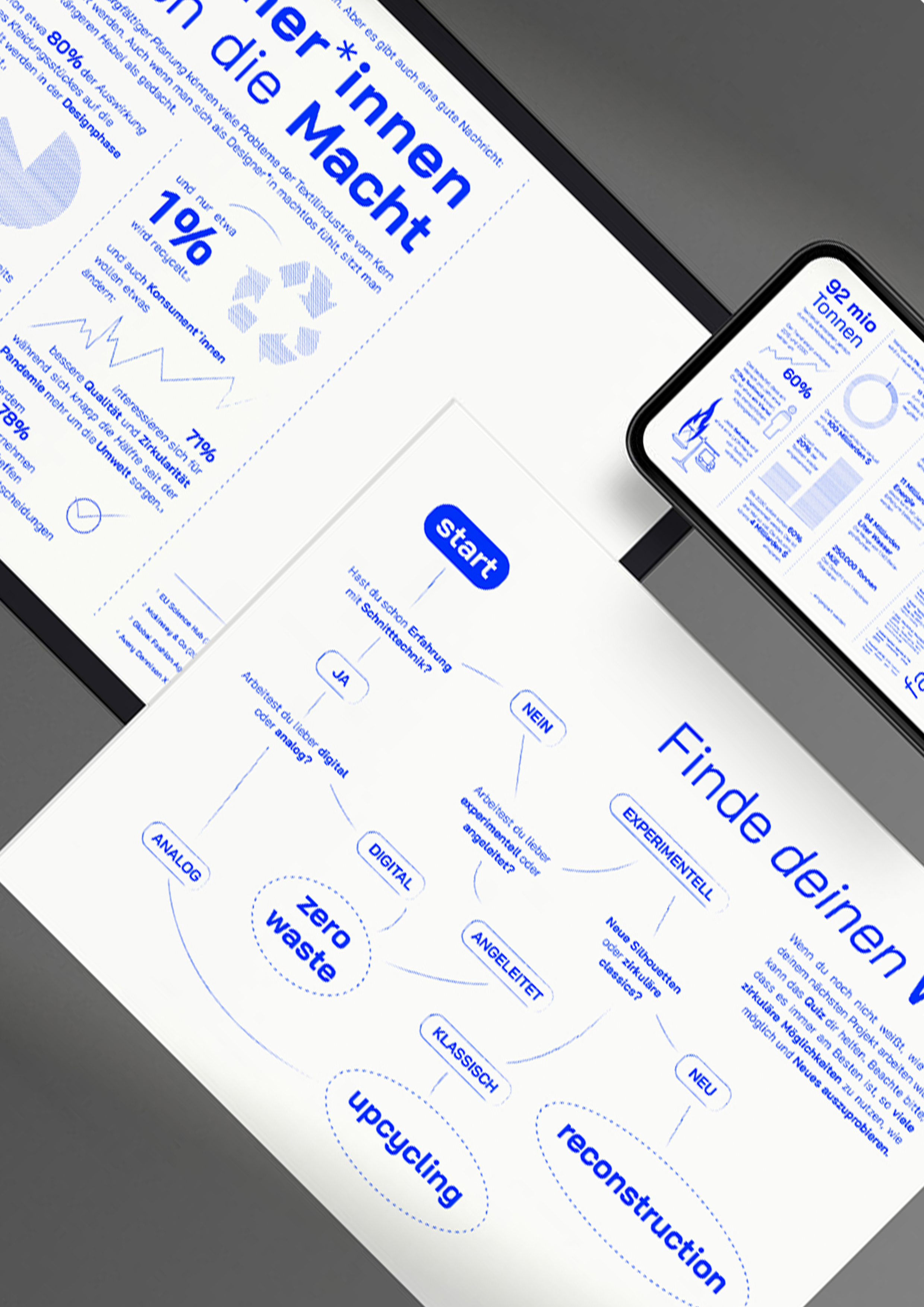
Based on the research the concept, information architecture, functions, and visual direction for the application were defined. This led to wireframes and a prototype.

VALIDATE & ITERATE
In the final phase, the concept was tested and adjusted through observation, usability testing, and AI heat mapping.
Teachers do not want additional workload but are willing to implement ready-made content into their teaching.
Teachers and students alike perceive circularity as an overwhelming topic.
Students find the subject too complex and morally burdensome; even when they are highly self-motivated, they feel left to their own devices.
Instructors do not feel educated in the topic and prefer to learn about it themselves before teaching.
Both user groups want social and participatory features as well as a space for questions, feedback and discussion.
Practical relevance, microlearning, and multisensory learning improve learning outcomes. Digital content should be visual, interactive, engaging, and practical—for example, through best practices, videos, or exercises.
Circularity is not uniformly established in either academia or industry.